01 / EXPLORE THE BUILDING BLOCKS
Rullst Showcase
A blog and application showcase. Explore server-rendered pages and selected integration demonstrations.
Explore ShowcaseThe open-source Rust framework suite
Intelligent. Security-Conscious.
Designed for Effortless Productivity.
Because With Rullst, We Rule! Go beyond the endpoint. Bring your data, identity, AI and product workflows together—with one coordinated toolchain and Rust you can actually inspect.
Axum + Tokio + Tower + SQLx. Your code. Your application policy.
# Start here, with the v12 CLI installed
$ cargo rullst new my_app$ cd my_app
$ cargo rullst dev
Workflow illustration · timings depend on your project
Generated code.
Not a black box.
00 / Less imagining. More exploring.
Explore three independently deployed applications on Azure Container Apps. Follow the source, discover a starting point, then make it yours.
A blog and application showcase. Explore server-rendered pages and selected integration demonstrations.
Explore ShowcaseDiscover a learning-platform example, with a public course catalog and account entry points.
Explore the LMSA portfolio starting point for presenting projects, skills and experience in a focused web application.
Explore PortfolioPublic demos, not production certifications. Snapshots may lag stable v12; Showcase payment fixtures are not live checkout. Use test data, not sensitive information. Availability is managed separately.
Source & deployment recipes ↗01 / More than a collection of crates
Start with a product-shaped foundation. Keep the freedom to understand and change what happens underneath.
Blank, blog, SaaS, LMS, portfolio or ERP. Generate ordinary Rust, follow a coordinated development loop and inspect your application with local tools.
Combine sessions, ownership guards, secure headers, CSRF and bounded request defenses. Your application still owns authorization and deployment policy.
Read the security model ↗Named providers and capability-declared OpenAI-compatible endpoints, with offline fixtures, resource limits and explicit tool permissions.
Explore the provider boundaries ↗Typed APIs, generated source, architecture rules and worked tutorials give humans and coding agents a common map. No claim that an AI-generated change is safe just because it compiles.
02 / A coordinated ecosystem
Sixteen publishable crates. Compose the capabilities your product needs; inspect the feature gates and limits before you enable them.
Grouped architecture map, not a dependency graph. IoT is a separately bounded foundation, not a v12 hardware-support promise.
03 / From your first route to your next idea
Choose a blueprint and database. Optional persistence adds zero or more specialized capabilities—not a second mandatory database.
Zero to Hero ↗Use supervised rebuild/restart during development. Failed builds retain the running application; successful restarts reset process-local state.
The development contract ↗Preview framework upgrades, apply backed-up changes and run compiler checks. Review migrations and application behavior before deployment.
Assisted upgrades ↗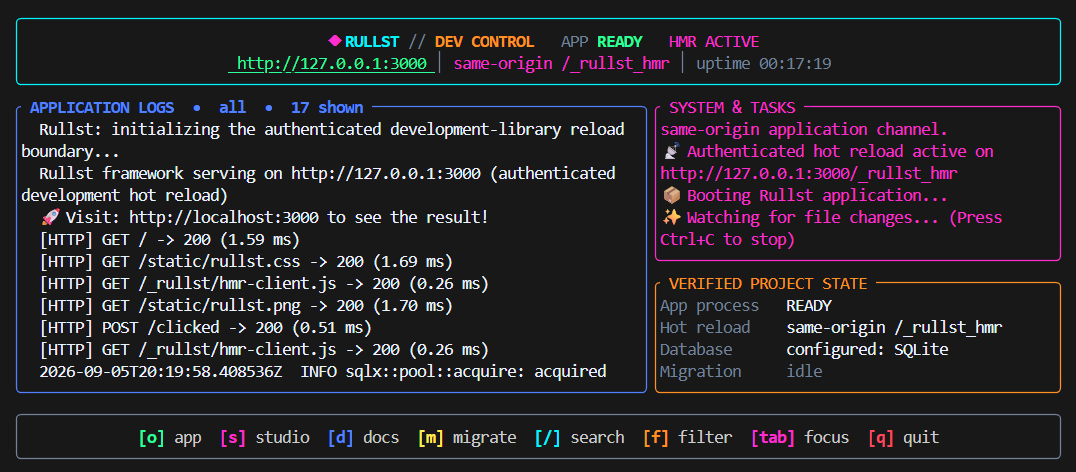
04 / Ambitious about the product. Precise about the proof.
No invented rankings. No universal-fastest claim. No green badge presented as a security certification.
Implementation, incomplete capabilities and roadmap boundaries in one place.
Inspect the status ↗ 02 / RELEASE REVIEWRelease evidence, corrections, bounded claims and the checks repeated for stable v12.
Open the release audit ↗ 03 / PERFORMANCEEight benchmark groups, exact workloads and methodology—not a production-throughput promise.
Explore benchmark history ↗Current CI, coverage and OpenSSF evidence are linked from the repository verification dashboard. Results belong to their recorded commits.
Open source. Open invitation.
Build something. Question an assumption. Bring a reproduction. Improve a tutorial. You don't need a huge pull request to make a meaningful difference.
v12.0.0 is the stable v12 release; use its exact crates.io version or immutable tag rather than the moving main branch. The legacy v5 branch is frozen and no longer maintained. Stable describes the framework API lifecycle, not automatic approval of an application's authorization, provider configuration, operations or deployment.
Check the release guide ↗